The Nashik Kumbh is not just an event; it’s the emotions and sentiments of crores of pilgrims with utmost faith in the Divine. The massive event occurs every 12 years, with the last one held in 2015. However, the Simhastha Kumbh of 2015 exposed multiple problems, including crowd management, sanitation, traffic congestion, and accommodation shortages. This sparked major concern among pilgrims, prompting authorities to prepare for a much larger, smarter event in 2027. From AI-powered surveillance to expanded roads and better connectivity, the Maharashtra government is working on major upgrades to eliminate the problems seen in 2015.
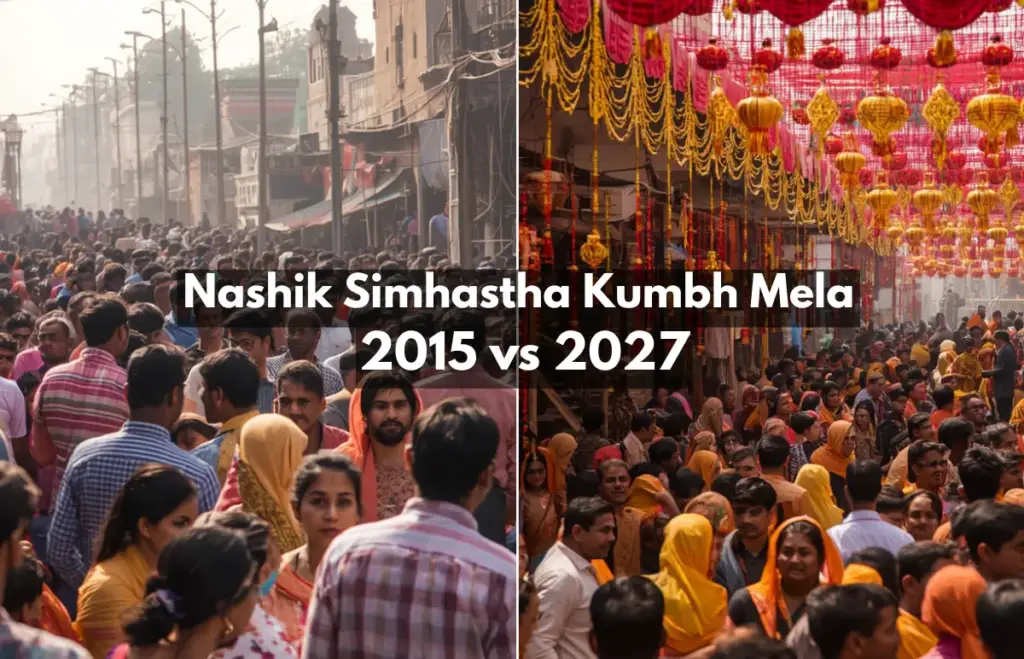
Why Nashik Kumbh 2027 Matters More Than 2015?
The Nashik Kumbh Mela attracts millions of pilgrims from across India and abroad and witnesses huge crowds, especially during Shahi Snan days. All this leads to heavy traffic, overcrowding, accommodation shortages, and pressure on civic infrastructure. Back in 2015, devotees who faced these issues could expect some dramatic changes in the upcoming Kumbh Mela.
The Nashik Kumbh Mela 2027 is anticipated to be the most technologically advanced and infrastructure-focused religious gathering India has ever planned. So if you are wondering: Is Nashik Kumbh 2027 better organised than the 2015 Kumbh Mela? The answer is yes. As authorities expect even larger footfall in 2027, they plan to make this event more like a mega smart-city operation.
Issues Faced in 2015 vs Expected Improvement in 2027
Massive Traffic Congestion
One of the biggest problems faced by the pilgrims during the 2015 Kumbh Mela was extreme traffic congestion. They spent hours stuck in one place due to narrow roads, poor parking systems, and unmanaged vehicle movement. This was mainly around areas like Nashik city, Panchavati, Ramkund, Trimbakeshwar, and Nashik Road Railway Station.
So, for the 2027 edition, authorities are focusing on large-scale road expansion, alternate routes, flyovers, and dedicated traffic corridors. To improve the overall Nashik Kumbh Mela infrastructure in 2027, new parking zones, dedicated shuttle routes, and temporary traffic diversions during Shahi Snan days will be set up.
Overcrowding at Bathing Ghats
In 2015, crowd movement near Ramkund and Kushavarta Kund created chaos during the peak Shahi Snan days. Despite manual barricading and a police-controlled crowd, long queues and bottlenecks increased safety concerns. So, in 2027, the use of AI-powered surveillance systems, drone monitoring, and smart CCTV networks will ease things up. Authorities are expected to use AI-based management tools to monitor crowd movement to make the Nashik Kumbh 2027 better organised.
Accommodation Shortages
Another major issue during the 2015 Kumbh was hotel shortages, whereas temporary camps also lacked proper sanitation. Considering these factors, prices surged heavily, and many pilgrims struggled to find safe accommodation near the main areas. For 2027, authorities are expected to develop better-regulated tent cities, online booking systems, and improved sanitation facilities to improve accommodation management.
Poor Railway Congestion Handling
Nashik Road Railway Station became extremely crowded in 2015, especially during the Shahi Snan. Due to this, pilgrims had to face long waiting times, platform overcrowding, difficult exits, and heavy traffic outside the station. With a focus on decentralizing pilgrim arrivals, authorities are seeking additional railway coordination, better bus integration, dedicated shuttle services, and improved highway connectivity. For pilgrims, smoother connectivity will directly improve the overall pilgrimage experience in 2027.
Sanitation and Waste Management
The huge volume of pilgrims in 2015 faced overflowing garbage, inadequate toilets, and river pollution after the peak Shahi Snan days. For a cleaner and more sustainable Kumbh in 2027, authorities are reportedly planning better sewage systems, more mobile toilets, smart waste collection, and large-scale cleanliness drives. The goal is to reduce environmental damage during the festival.
How AI and Smart Management Replace 2015’s Manual Policing
Kumbh Mela remains one of the largest human gatherings on earth, with crores of devotees arriving within short periods. The 2015 Kumbh was all about manual policing and ground staff coordination. Even though thousands of police officers were deployed on the ground, managing crores of people manually was not a piece of cake.
However, compared to 2015, 2027 appears to be far more prepared and is expected to introduce AI-assisted crowd alerts, smart traffic management systems, real-time public announcements, and integrated disaster management control rooms. While the event may still feel crowded, it will be more controlled and organised. Compared to 2015, the pilgrims can benefit in the following ways:
| 2015 Experience | 2027 Expected Improvement |
| Manual crowd estimation | AI crowd prediction |
| Delayed police response | Real-time monitoring |
| Traffic confusion | Smart route guidance |
| Lost-person challenges | Digital assistance systems |
| Poor communication | Centralised live coordination |
What is the budget for the Nashik Kumbh Mela 2027?
With the grandeur associated with the massive event, everyone is curious about the Nashik Kumbh 2027 Budget. If reports are to be believed, authorities have shelled out several thousand crores for infrastructure spending on roads, riverfront development, transport systems, sanitation, and crowd management. Rather than focusing only on religious management, the government is emphasising on creating long-term urban infrastructure for Nashik city itself.
Compared to the 2015 Nashik Kumbh, the budget is significantly larger because authorities are anticipating a much higher footfall. The Nashik Kumbh 2027 budget includes work on road expansion, water supply systems, smart surveillance, sewage treatment, river cleaning, temporary accommodation zones, public transportation upgrades, and disaster management systems.
Final Words
So, if you are still wondering, ‘Is Nashik Kumbh 2027 better organised than the 2015?’ The answer appears to be yes. The 2027 edition is being designed to address the shortcomings in the 2015 Kumbh, all thanks to current planning and infrastructure upgrades. This time, manual management will be replaced by smart-city style coordination powered by AI monitoring and better connectivity. If all these projects are completed on time, the Nashik Kumbh Mela 2027 could become one of the best ones yet.
Frequently Asked Questions (FAQs)
Yes, Nashik Kumbh Mela 2027 will be more organised than the one in 2015, as the government has introduced plans to bring major improvements in crowd management, roads, sanitation, AI surveillance, and digital coordination.
The total infrastructure and preparation budget is expected to run into several thousand crores. The upgrades will include roads, transport, sanitation, crowd management, and accommodation.
Yes, the authorities are dedicated to bringing better safety management and are expected to use AI-based crowd monitoring, smart surveillance systems, drones, and centralised control rooms.
The attendees will witness major upgrades, including wider roads, improved railway connectivity, shuttle transport systems, smart crowd control technology, sanitation improvements, and organised accommodation.